Table of Contents
- Why Replacing Galvanized Pipes in Homes Matters
- Signs of Galvanized Plumbing You Should Not Ignore
- What Galvanized Pipe Replacement Cost Looks Like
- The Best Replacement for Galvanized Pipes
- Galvanized Pipe Replacement Timeline and What to Expect
- Permits, Inspections, and Choosing a Licensed Plumber
- Conclusion
- Frequently Asked Questions
Last Updated: October 21, 2026
Why Replacing Galvanized Pipes in Homes Matters
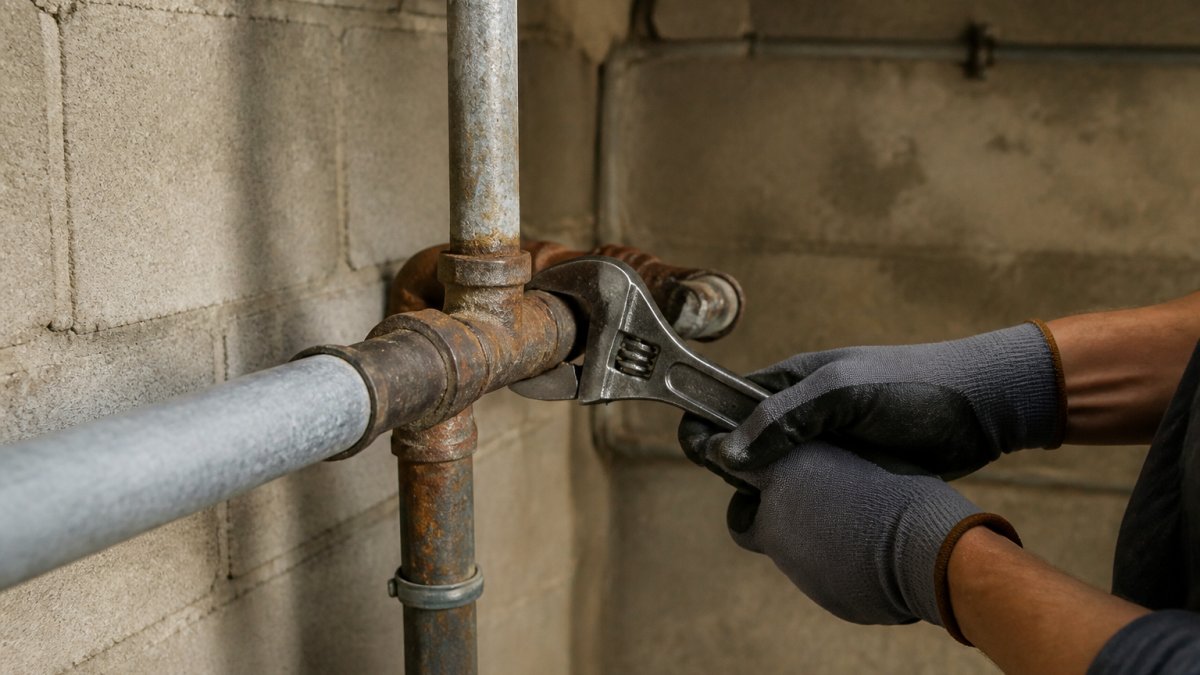
Replacing galvanized pipes in homes means removing aging zinc-coated steel water lines and installing modern copper or PEX throughout the supply system.
Galvanized steel was never meant to last forever. The zinc coating wears away from the inside out, and once it’s gone, the pipe rusts from within.
Many homes built before the mid-1970s still have galvanized plumbing behind the walls.
Below, we cover the warning signs, replacement costs, the best material, and how the project unfolds.
Signs of Galvanized Plumbing You Should Not Ignore
The clearest signs of galvanized plumbing are rusty or discolored water, falling water pressure, and visible zinc-coated steel pipe at exposed connections. Any one warrants an inspection before a small problem becomes a flooded basement.
Watch for these red flags:
- Rust-colored water, especially after a vacation when water sat in the lines
- Metallic taste in drinking water that doesn’t clear after running the tap
- Low water pressure at fixtures that used to flow strongly
How to Confirm You Have Galvanized Steel Pipe
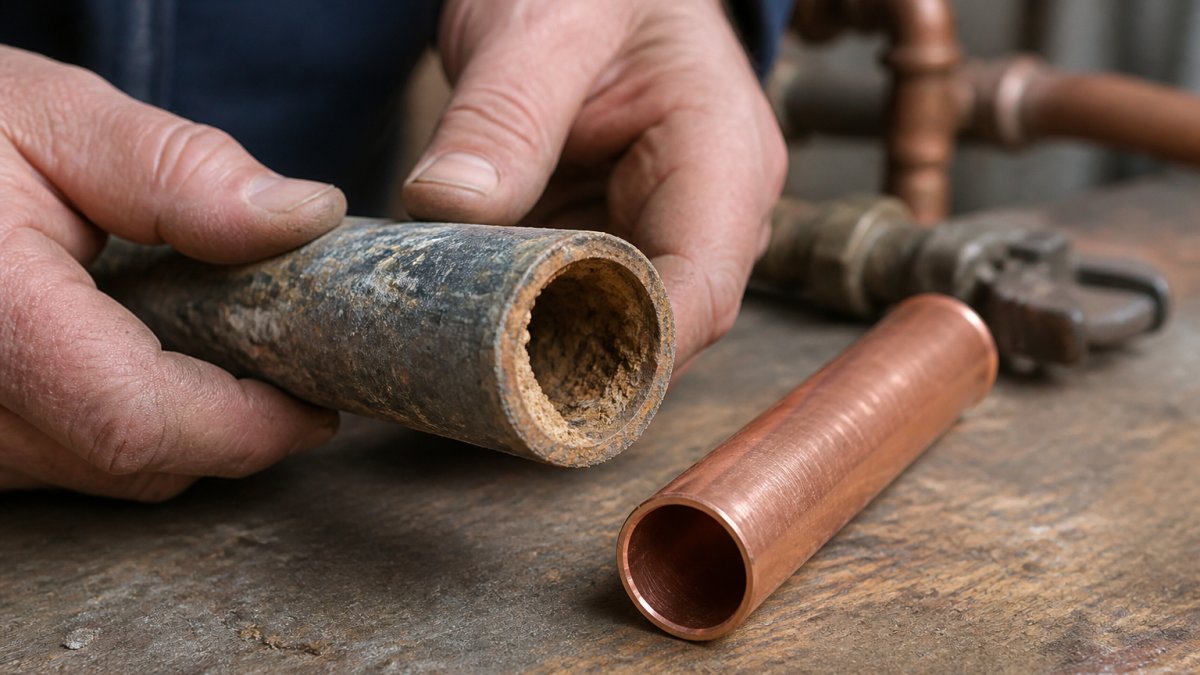
Find an exposed pipe near your water heater, meter, or basement ceiling and look at its surface. Galvanized steel has a dull gray, slightly mottled finish and feels magnetic. Scratch it gently with a coin: shiny silver beneath the gray is the zinc coating. Copper is reddish-brown and non-magnetic; PEX is white, red, or blue plastic tubing. If you can’t reach an exposed section, check the home’s age and ask a licensed plumber to confirm during an inspection.
Don’t assume fresh-looking paint means the pipe is fine. Galvanized lines are often painted over, and the corrosion happens on the inside where no paint can reach it.
What Galvanized Pipe Replacement Cost Looks Like
Galvanized pipe replacement cost depends on home size, fixture count, whether walls need opening, and material choice. Every house differs, so we quote each project individually after seeing the layout rather than guessing over the phone.
Repiping is priced by scope, not a single national rate, so the useful skill is knowing which line items should appear on every estimate.
The cost components that should appear on every quote
A complete repiping estimate is built from six buckets. If a quote is missing any, ask why before comparing totals.
- Access and wall openings, cutting into drywall, plaster, or ceilings to reach concealed runs, plus the patch, sand, and paint to close them back up. In a finished basement or a home with plaster walls, this is often the single largest swing factor.
- Demolition and removal, draining and cutting out the old galvanized lines, and disposing of the steel, which is heavy and bulky.
- New material and fittings, copper or PEX, plus manifolds, shutoff valves, transition fittings where new pipe meets any remaining old pipe, and hangers or clips.
How to compare two estimates fairly
Two quotes for the same house can differ by thousands of dollars and both be legitimate, because they may describe different scopes. Compare them line by line:
- Is the permit included, and who pulls it? A quote that excludes permits is not cheaper, it just moves the cost and the risk to you.
- Is drywall repair and repainting included, or “by others”? Restoration is frequently the line that turns a low bid into an average one.
- How many fixtures are being reconnected? Count them yourself: sinks, toilets, showers, tubs, laundry, dishwasher, fridge line, hose bibs, and the water heater.
- What happens at the transition to any pipe that stays? If part of the system remains, the quote should specify the transition fittings and who warrants that joint.
- What is the warranty, and does it cover labor as well as material? Material warranties from manufacturers are common; labor warranties are what protect you.
- Is the price fixed or hourly? A fixed price with a defined scope is easier to hold a contractor to.
A quote that is dramatically lower than the others usually excludes restoration, permits, or fixture reconnections. Ask for the exclusions in writing before you treat it as the cheapest option.
Partial Replacement vs. Whole-Home Repiping
Partial replacement targets only the worst sections, usually the runs feeding the kitchen or bathroom. Whole-home repiping replaces the entire supply system at once. Here’s how to decide:
| Situation | Recommended Approach | Why |
|---|---|---|
| One isolated leak, rest of system tested sound | Partial replacement | Lower upfront cost |
| Multiple leaks or widespread pressure loss | Whole-home repiping | Avoids repeat openings |
| Renovating a kitchen or bathroom anyway | Replace lines in that zone | Walls are already open |
| Planning to sell within a few years | Whole-home repiping | Protects resale value |
A common mistake is patching one leak and assuming the rest will hold. If one section has failed, the others are usually on the same timeline.
A practical framework for partial versus whole-home
Treat this as four questions:
- How much galvanized is left? If the visible runs are already copper or PEX and only one zone is steel, a partial replacement can be rational. If the majority of the supply system is still galvanized, partial work tends to be the first of several projects.
- What is the condition of what stays? A plumber can assess wall thickness, scale buildup, and joint condition at accessible points. Pipe that is scaled and thinning at the joints is on the same clock as the section that already failed.
- What is your renovation horizon? If you plan to open walls for a kitchen or bathroom in the next year or two, replacing the lines in that zone while the walls are open is far cheaper than doing it later.
We publish current pricing on our website and provide clear quotes with no hidden fees, so you can see the breakdown before work begins.
The Best Replacement for Galvanized Pipes
The best replacement for galvanized pipes is PEX or copper, depending on layout, budget, and local code.
Copper pipe is durable, handles heat well, and is widely accepted by inspectors. It costs more in material and labor, requires soldering or press fittings, and its rigidity means more joints inside walls.
PEX pipe is flexible tubing that routes easily through existing walls with fewer joints, reducing leak points.
Material comparison beyond lifespan
| Factor | Copper | PEX |
|---|---|---|
| Lifespan | Decades with proper water chemistry | Long service life |
| Freeze behavior | Rigid; can split under freezing expansion | Flexible; more forgiving but not freeze-proof |
| Joints inside walls | More fittings and soldered or press joints | Fewer joints; mechanical fittings at manifolds |
| Heat tolerance | High; suitable for hot-water lines near the heater | Rated for hot water within manufacturer limits |
| UV exposure | Unaffected | Degrades in sunlight; must be protected |
| Existing-pipe transition | Requires dielectric fittings to avoid galvanic corrosion | Requires approved transition fittings |
| Installation speed | Slower; soldering or pressing | Faster; fewer joints to make |
Code, climate, and installation considerations
- Code acceptance. Both copper and PEX are widely recognized in Canadian plumbing codes, but requirements vary by jurisdiction and application. Confirm the proposed material and fittings meet the applicable code for your area before work starts.
- Cold-climate routing. In unheated spaces such as crawlspaces, rim joists, and exterior walls, freeze risk matters more than material price. PEX tolerates some expansion better than rigid copper, but neither is immune. Insulation, heat tracing, and routing on the warm side of the building envelope are the real protections.
- Compatibility with what stays. If any galvanized pipe remains, the transition between steel and copper needs a dielectric fitting to prevent galvanic corrosion at the joint. PEX transitions use approved mechanical fittings. The quote should name these fittings explicitly.
Ask your plumber to confirm the proposed material meets the requirements of the applicable plumbing code for your area before work starts. It saves a failed inspection later.
When to test your water before choosing a material
Water testing cannot tell you whether your pipes need replacing, only an inspection of the pipe can. A test distinguishes pipe corrosion from other water-quality problems and informs material choice.
- Test when you notice discoloration that clears after running the tap, a metallic taste, or you are on a private well with no recent test on file.
- What results can establish: general chemistry such as pH, hardness, and dissolved solids, which help a plumber judge whether aggressive water may shorten the life of copper.
- What results cannot establish: whether a specific pipe section is thin, scaled, or about to fail. That requires looking at the pipe.
A qualified plumber can combine visual inspection with water chemistry to recommend a material suited to your house.
Galvanized Pipe Replacement Timeline and What to Expect
A typical whole-home repiping project runs two to five working days, depending on home size and access. The galvanized pipe replacement timeline breaks into clear phases so you can plan around the disruption.
- Inspection and quote (same day to a few days)
- Permit application (varies by municipality)
- Water shutoff and system drain (a few hours)
- Removal and new pipe installation (one to three days)
- Fixture reconnection and pressure testing (half a day to a day)
- Inspection and wall restoration (scheduled after rough-in)
Expect the water off during working hours and some drywall patching where lines were accessed. We schedule around your routine and confirm arrival windows in advance.
Permits, Inspections, and Choosing a Licensed Plumber
Repiping generally requires a permit and inspection under local plumbing regulations, and hiring a licensed plumber protects you if something goes wrong. Confirm licensing and insurance before anyone touches a pipe.
What to check before you hire:
- Valid plumbing licence and liability insurance
- Written quote with a clear scope and no hidden fees
- Confirmation that permits and inspections are included
At Spencer4Hire Plumbing, our licensed and insured plumbers handle repiping, fixture installation, and 24/7 emergency calls, with same-day or next-day service and warranties on the work. For official guidance on plumbing requirements, check your municipal building and plumbing permit information and the Canadian plumbing code resources.
The cheapest quote often excludes permits, restoration, or warranty coverage. Compare total scope, not just the headline number.
Conclusion
Aging galvanized plumbing won’t fix itself, and every month you wait raises the odds of a burst pipe and water damage. If your home shows the warning signs, get an inspection and a clear quote before an emergency decides the timeline.
Spencer4Hire Plumbing provides licensed, insured repiping with transparent pricing, same-day or next-day scheduling, and true 24/7 emergency support. Call now to book your inspection and protect your home’s plumbing system.
Frequently Asked Questions
Is it worth it to replace galvanized pipes?
In most cases, yes. Galvanized steel pipe corrodes from the inside out, so the zinc coating wears away and the pipe narrows with rust and mineral buildup. That leads to restricted flow, discolored water, pinhole leaks, and eventually burst pipes and water damage. Replacing galvanized pipes restores water pressure, improves water quality, and protects resale value. A licensed plumber can inspect your plumbing system and tell you whether a partial replacement or whole-home repiping makes sense for your house.
How much does galvanized pipe replacement cost?
Galvanized pipe replacement cost depends on the size of the home, how many fixtures and water supply lines are involved, whether walls need to be opened, and the material you choose. Whole-home repiping costs more than a partial replacement, and access issues (finished basements, second floors) add labor. Because every house is different, the reliable way to get a number is a written quote after an on-site inspection. Ask for an itemized breakdown of labor, materials, and restoration so there are no surprise charges.
How can you tell if your home has galvanized pipes?
Look at exposed pipes in the basement, utility room, or under sinks. Galvanized steel pipe is dull gray and often shows rust, and a magnet will stick firmly to it. You may also notice a threaded fitting at the joints, which is common on galvanized plumbing. Other signs of galvanized plumbing include low water pressure, rust-colored water after a vacation, and a metallic taste. A plumbing inspection confirms the pipe material and the condition of the inside of the pipe.
What is the best replacement for galvanized pipes?
PEX and copper are the two common choices. PEX pipe is flexible, resists corrosion and freezing damage better, needs fewer connections, and usually costs less to install. Copper pipe is rigid, long-lasting, and familiar to insurers and inspectors, but it costs more and takes more labor. The best replacement for galvanized pipes depends on your budget, local code, and how your home is built. A licensed plumber can recommend the right pipe material for your layout.
How long does it take to replace galvanized pipes in a house?
The galvanized pipe replacement timeline for a typical home runs from a few days to about two weeks. A partial replacement of one run or a bathroom can finish in a day or two, while whole-home repiping with wall openings and restoration takes longer. Access, the number of fixtures, and whether you stay in the home during the work all affect the schedule. Your plumber should give you a written timeline and explain when the water shutoff will happen.
Can you replace only part of a galvanized plumbing system?
Yes, partial replacement is possible and sometimes sensible. If one section has failed but the rest is still sound, replacing that run can buy time. The catch is that galvanized pipe corrodes throughout the plumbing system, so a patch often leads to another repair soon after. A practical decision framework weighs pipe age, water pressure readings, leak history, and whether you plan to renovate. Ask your plumber to compare partial replacement against whole-home repiping on cost and lifespan.